
Join with me and read more - Your's Karthick
Showing posts with label Temple. Show all posts
Showing posts with label Temple. Show all posts
Friday, January 19, 2024


Thursday, June 20, 2013
Arulmigu Ramanathaswamy Temple
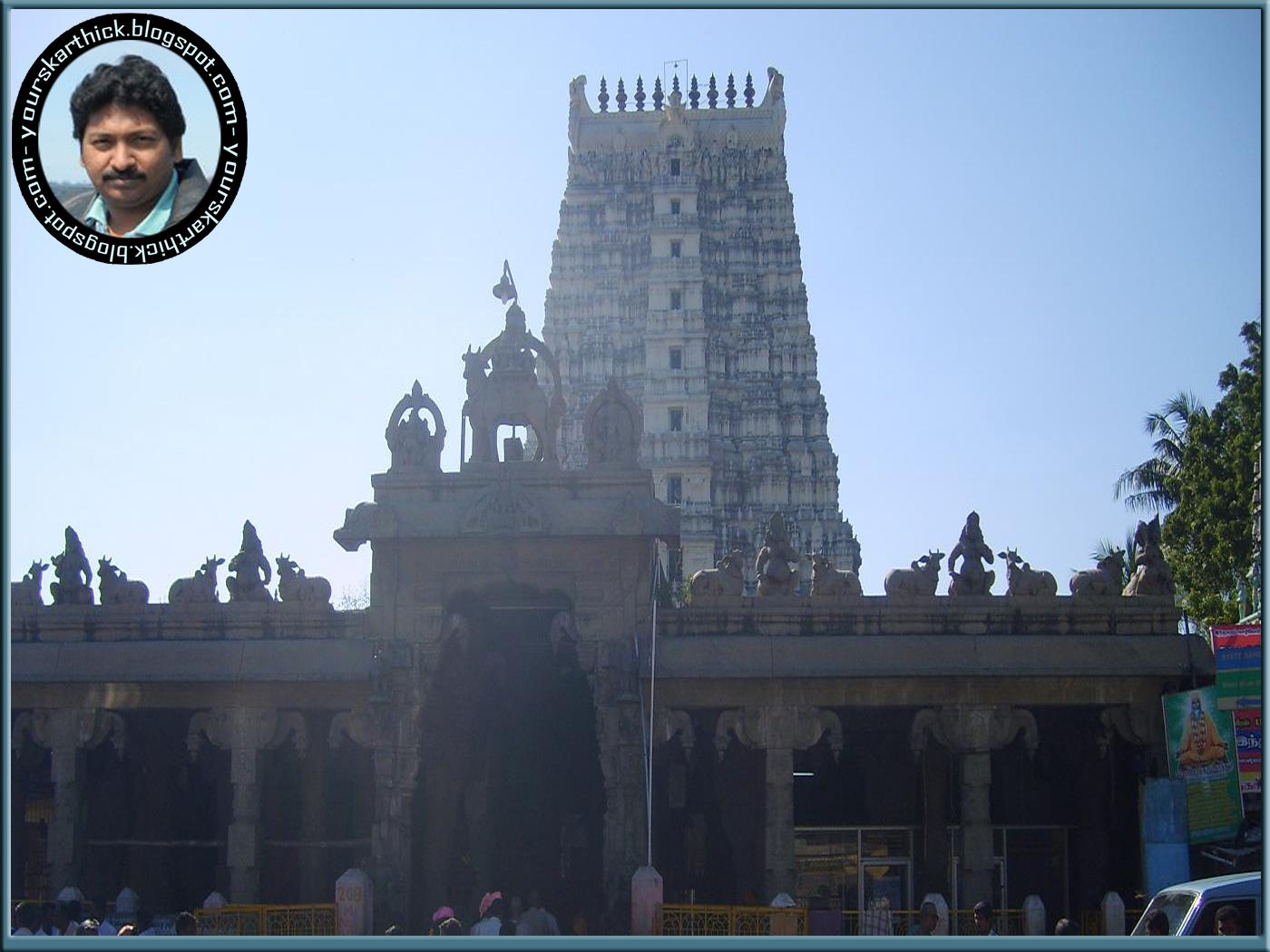
The temple and the island of Rameswaram have acquired this name because, Lord Rama worshipped Lord Shiva, the God of Gods here on return from Sri Lanka. According to legend, after killing Ravana Lord Rama returned with his consort Goddess Seetha to India first stepping on the shores of Rameswaram. To expiate the "dosha" of killing a brahmin, Lord Rama wanted to offer worship to Lord Shiva. Since there was no shrine in the island had despatched Sri Hauman to Kailash to bring an idol of Lord Shiva.
Between 1897 and 1904, the ALAR family of Devakottai completed the imposing eastern tower of nine tiers 126 feet in height from Thiruppani funds. Between 1907 and 1925 they renovated the Sanctum Sanctorum and the prakaram(inner most corridor) by replacing the lime stones by black granite with adequate provision for light and ventilation and also arranged for the performance of Ashtabandana Kumbabishekam in 1925; then on 22-2-1947 and the third Ashtabandana Maha Kumbabishegam was performed on 5-2-1975.

World Famous Third Corridor :
Outer Wing - East_West – 690 feet
North-South - 435 feet
Innerwing - East_West - 649 feet
North-South - 395 feet
Total number of pillars – 1212
Height of Corridor – 22 feet 7 ½ inch
Second Corridor :
During the construction of first corridor, it was decided to renovate the second corridor. The lime stone structure in Second corridor was dismantled and started granited stone work. But only compound wall in west side and one portion in north side of western wing in south gate was renovate. After that no Renovation work as done.
Therefore, it was proposed to complete the Renovation work of Second Corridor by collecting Funds from the public. Between 1961 to 1985, the Renovation work of Second Corridor was taken up and completed the western side of Second Corridor and a portion in North and South side, from the Temple Renovation Fund. Now it has been proposed to complete the Renovation of Second Corridor which has been unfinished and the Renovation work is started now.
The Sethupathy mandapam in front of the Temple’s Raja Gopuram9main Tower) was constructed by Ramanatha Sethupathy, a descendant of Ramnad Raja dynasty, with his own donation of Rs. 2,75,000 /-. This construction was started on 19-11-69 and completed on 11-2-74.
It is also most essential to construct the North and South Gopurams. Shri Jagadguru Sringeri Peedathipathy and Shri jagadguru Kanchi Kamakoti Peedathipathy have given their kind blessings for the constructions of the North and South Gopurams of the Temple.
Worship :
The temple will be kept open for the devotees from 5 A.M to 9 P.M(except between 1 P.M and 3 P.M). The poojas are performed six times a day in this temple.
Details of Pooja Timings
1. Palliyarai Deepa Arathana 05:00 A.M
2. Spadigalinga Deepa Arathana 05:10 A.M
3. Thiruvananthal Deepa Arathana 05:45 A.M
4. Vila Pooja 07:00 A.M
5. Kalasanthi Pooja 10:00A.M
6. Uchikala Pooja 12:00 NOON
7. Sayaratcha Pooja 06:00 P.M
8. Arthajama Pooja 08.30 P.M
9. Palliyarai Pooja 08:45 P.M
Palliyarai ( Sayanangriha) Procession of Swami and the Palliyarai Pooja for Swami and Ambal in the Sayanagriha in Ambal Shrine are performed between 8.45 and 9.00 PM. In additions to the regular poojas at prescribed periods, poojas are also performed by the priests on behalf of individual pilgrims as they come with their tickets obtained from the Devasthanam office.
Pilgrims who wish to offer cash, gold or silver ornaments or other valuable articles should produce them before the temple Peishkar who will arrange to have them placed at the feet of the Lord or Devi as the case may be and get them entered in the temple accounts and issue proper receipts.
Devotees who desire to endow lands or other immovable property should contact the Treasurer or Executive Officer of the temple and arrange to have the prescribed Deeds executed with the approval of the Board of Trustees and legal officers.
Ganga water to be accepted from Abhishekam should be brought in brass, copper or bronze vessels and such vessels will be accepted on payment of the prescribed fees per vessel to Peishkar. Vessels made of tin or iron will not be accepted; but those who bring such vessels should pay for copper or brass vessels available in the temple and the peishkar will have the Ganga water transferred to temple vessels after satisfying himself about the genuineness of the water. Ganga water can also be sent by post or rail with prescribed fee per vessel and an additional One rupee.
A hundi box is available at the main entrance to each sannidhi into which devotees can put their cash offerings. The hundi boxes are opened periodically in the presence of officers and the public and the proceeds are taken to the temple account.
Inside Theerthams:


Worship :
The temple will be kept open for the devotees from 5 A.M to 9 P.M(except between 1 P.M and 3 P.M). The poojas are performed six times a day in this temple.
Details of Pooja Timings
1. Palliyarai Deepa Arathana 05:00 A.M
2. Spadigalinga Deepa Arathana 05:10 A.M
3. Thiruvananthal Deepa Arathana 05:45 A.M
4. Vila Pooja 07:00 A.M
5. Kalasanthi Pooja 10:00A.M
6. Uchikala Pooja 12:00 NOON
7. Sayaratcha Pooja 06:00 P.M
8. Arthajama Pooja 08.30 P.M
9. Palliyarai Pooja 08:45 P.M
Palliyarai ( Sayanangriha) Procession of Swami and the Palliyarai Pooja for Swami and Ambal in the Sayanagriha in Ambal Shrine are performed between 8.45 and 9.00 PM. In additions to the regular poojas at prescribed periods, poojas are also performed by the priests on behalf of individual pilgrims as they come with their tickets obtained from the Devasthanam office.
Pilgrims who wish to offer cash, gold or silver ornaments or other valuable articles should produce them before the temple Peishkar who will arrange to have them placed at the feet of the Lord or Devi as the case may be and get them entered in the temple accounts and issue proper receipts.
Devotees who desire to endow lands or other immovable property should contact the Treasurer or Executive Officer of the temple and arrange to have the prescribed Deeds executed with the approval of the Board of Trustees and legal officers.
Ganga water to be accepted from Abhishekam should be brought in brass, copper or bronze vessels and such vessels will be accepted on payment of the prescribed fees per vessel to Peishkar. Vessels made of tin or iron will not be accepted; but those who bring such vessels should pay for copper or brass vessels available in the temple and the peishkar will have the Ganga water transferred to temple vessels after satisfying himself about the genuineness of the water. Ganga water can also be sent by post or rail with prescribed fee per vessel and an additional One rupee.
A hundi box is available at the main entrance to each sannidhi into which devotees can put their cash offerings. The hundi boxes are opened periodically in the presence of officers and the public and the proceeds are taken to the temple account.
Inside Theerthams:
The Theerthams of the Temple inside the Corridor and their significance,
1. Mahalakshmi Theertham :
Location : South of the Hanuman Temple.
Significance : Dharmarajan bathed here and became rich.
2. Savithri Theertham :
Location : West of the Hanuman Temple.
Significance : King Kasibar got rid of his curse.
3. Gayathri Theertham :
Location : West of the Hanuman Temple.
Significance : King Kasibar got rid of his curse.
4. Saraswathi Theertham :
Location : West of the Hanuman Temple.
Significance : King Kasibar got rid of his curse.
5. Sethu Madhava Theertham :
Location : The Tank at the third corridor.
Significance : One will get lakshmi's blessings and purification of heart.
6. Gandhamadana Theertham :
Location : In the area of the Sethumadhava Temple.
Significance : One will get riches and their sins will be absolved after getting rid of their penury.
7. kavatcha Theertham :
Location : In the area of the Sethumadhava Temple.
Significance : One will not go to hell.
8. Gavaya Theertham :
Location : In the area of the Sethumadhava Temple.
Significance : Shelter under karpaga Virutchaga Tree.
9. Nala Theertham :
Location : In the area of the Sethumadhava Temple.
Significance : One will get Soorya Thejas and reach Heaven.
10. Neela Theertham :
Location : In the area of the Sethumadhava Temple.
Significance : One will get the benefit of Samastha(entire) yaga and receive Agni Yoga.
11. Sanku Theertham :
Location : In the inner corridor of the Temple.
Significance : Vathsanaba, the Sage, got rid of his sin of ingratitude.
12. Sakkara Theertham :
Location : In the inner corridor of the Temple.
Significance : The Sun got His hand turned golden.
13. Brahmahathi Vimochana Theertham :
Location : In the inner corridor of the Temple.
Significance : Brahamahathi was absolved of his sins.
14. Sooriya Theertham :
Location : In the inner corridor of the Temple.
Significance : One will get the knowledge of the past present and the future and reach the worlds they want.
15. Chandra Theertham :
Location : In the inner corridor of the Temple.
Significance : One will get the knowledge of the past present and the future and reach the worlds they want.
16. Ganga Theertham :
Location : In the inner corridor of the Temple.
Significance : Gananasuruthi Rajah attained wisdom.
17. Yamuna Theertham :
Location : In the inner corridor of the Temple.
Significance : Gananasuruthi Rajah attained wisdom.
18. Gaya Theertham :
Location : In the inner corridor of the Temple.
Significance : Gananasuruthi Rajah attained wishdom.
19. Siva Theertham :
Location : South of nandi Deva in the Temple.
Significance : Completion of Bhaira Brahmahathi.
20. Sadyamirtha Theertham :
Location : In the Amman Sannathi.
Significance : Emperor Bururoonu got rid of his curse.
21. Sarva Theertham :
Location : In front of Lord Ramanatha's sannathi.
Significance : Sutharishna got rid of his blindness(from birth), illness and old age and then he prospered.
22. Kodi Theertham :
Location : In the first corridor of the Temple.
Significance : Sri Krishna got rid of his Sin of killing his Uncle, kamsan.
Outside Theertham
The Theerthams Outside the Temple, Their Location and Their Significance,
1. Vedhala Varatham Theertham :
Location : South of Mandapam.
Significance : SudharIsanan got rid of his curse.
2. Papa Vinasa Theertham :
Location : South of Mandapam.
Significance : Brahmana and Sudra, who committed heinous sins got expiated and attained Heaven.
3. Bhairava Theertham :
Location : In Pamban.
Significance : Relief from Brahmahathi Dhosham.
4. Kabhi Theertham :
Location : In Pamban.
Significance : Aramba got rid of curse.
5. Seetha Kundam :
Location : North of Thangachimadam.
Significance : Indra got rid of Brahamahathi.
6. Mangala Theertham :
Location : North of Thangachimadam.
Significance : King Manojava got his Kingdom.
7. Amirtha Valli Theertham :
Location : In Sri Ekanda RamaswamI Temple.
Significance : Agasthiya’s brother attained heaven Sarva abhishta Siddhi.
8. RANA Vimosana Theertham :
Location : North of Sri Ekanda RamaswamI temple.
Significance : Relief from all debts.
9. Lakshmana Theertham :
Location : On the Rameswaram – Pamban Road
Significance : Balaraman got rid of Brahmahathi
10. Rama Theertham :
Location : On the Rameswaram – Pamban Road.
Significance : Dharmarajan got rid of his Sin of telling a lie.
11. Seetha Theertham :
Location : On the rameswaram – pamban Road.
Significance : Dharmarajan Got rid of his Sin telling a lie
12. Sukreeva Theertham :
Location : On the way to Ganthamathana Parvatham.
Significance : One will get complete wisdom and attain Soorya Loka.
13. Angatha Theertham :
Location : On the way to Ganthamathana Parvatham.
Significance : Attaining the position of Devendra.
14. Jambava Theertham :
Location : On the way to Ganthamathana Parvatham.
Significance : Longevity of life.
15. Gandhamadhana Theertham :
Location : On the way to Gandhamadhana Parvatham.
Significance : Reaching Vaikunda.
(16-20) Panja Pandava Theertham.
16. Dharma Theertham
17. Bhima Theertham
18. Arjuna Theertham
19. Nahula Theertham
20. Sahadeva Theertham :
Significance : Ishtartha Siddi. Getting the things we want.
21. Dhroupathi Theertham :
Location : Near Sri Bhadrakali Temple.
Significance : Ladies will get long life with the love of their spouses.
22. Brahma Theertham :
Location : Near Sri Bhadrakali Temple.
Significance : Bramadevi got rid of his curse.
23. Hanuma Gunda Theertham
Location : Near Sri Bhadrakali Temple.
Significance : King Dharma Saga got a son.
24. Naga Theertham :
Location : North-East of the Temple at the Devasthana madam.
Significance : Those, who bathe in this along with all other Theerthams including the Ganga Theertham will attain heaven.
25. Agasthiya Theertham :
Location : North East of the Temple.
Significance : Katchivan got Manoramai.
26. Jadayu Theertham :
Location : On the way to Dhanuskodi.
Significance : Pirugu, Dhathathreya, Dhurvasa and Suga got purity of heart.
27. Dhanushkodi Theertham
Location : The sea in Dhanuskodi(Confluence of the Rivers Rathnaharam and Mahodathi).
Significance :
» Asuvathaman got rid of his sin of killing those who were sleeping.
» Dharma Gupta got rid of his insanity.
» Para Vasu, A Brahman, got rid of his Brahmahathi Dhosham.
» Sumathi got rid of Mahapathagam.
» Dhurasaran got rid of Samsarkka Bathaga Dhosham.
28. Deva Theertham :
Location : In front of Sri Rama Sannathi.
Significance : Indra made a yagam to win the Asuras.
29. Kajan Theertham :
Location : In front of Sri Rama Sannathi.
Significance : Relief from all sins.
30. Saravana Theertham :
Location : In front of Sri Rama Sannathi.
Significance : Relief from all sins.
31. Kumuthan Theertham :
Location : In front of Sri Rama Sannathi.
Significance : Relief from all sins.
32. Haran Theertham :
Location : In front of Sri Rama Sannathi.
Significance : Relief from all sins.
33. Panagan Theertham :
Location : In front of Sri Rama Sannathi.
Significance : Relief from all sins.
34. Vibeeshana Theertham :
Location : In front of Sri Rama Sannathi.
Significance : Relief from mental agony, all sins, poverty, and Dhushvapanam.
Pilgrims should take their own vessels and rope and draw water out of the Theerthams(mostly wells) in different parts of the temple. No water should be allowed to go into the wells after bath. The baths refresh both the mind and the body. The waters have medicinal properties besides that the mystic SANCTITY attached to each of them.
The 31 Theerthams outside of the temple, extend from Devipatnam(Navapashanam) and Tirupullani (Darbhasayanam) near Ramnad to Mandapam. Pamban Thangachimadam and Rameswaram though they are the treat traditional importance, many of them have not been properly maintained and so most of the pilgrims do not take the trouble of visiting these places. Several of them are also not easily accessible.
Saturday, May 11, 2013
Madurai Thiruparankundram Murugan Temple

Thiruparankundram temple is dedicated to the Lord Subramaniya. It is situated 8km south from Madurai district. Thiruparankundram is one of the six abodes of Lord Subramaniya. This is cave temple, One of the sangam poet Nakkirar has sung a log poem about this Temple is called Thirumurugatrupadai.

Devayanai Marriage, Thirumalai Nayak and Mangammal Sculptures are there in this temple. The most important sculputure is Lord siva with flag of Rishaba in his hand cannot be found anywhere else. The important festival in this Temple is Vaigasi visagam, which is celebrated as Lord Subramaniyar's birthday, and Surasamharam, which is celebrated in the month November or December every year.
Presiding deities of the temple are Lord Muruga and Goddess Devasena. Other deities - Shiva, Vishnu, Durga and Ganapathy - are represented as well.

Entrance in the ancient cave temple leads through a row of massive square pillars ornamented with lotus-shaped medallions.
Inside the cave temple there has been preserved ancient painting of Nataraja - dancing Shiva. Cave temple contains also the sculpture of presiding deity Sri Subramaniyaswamy (Muruga). Rock-cut temple contains also 41 inscriptions revealing the early history of the temple. Before the ancient rock-cut temple there is built front part - mugha mandapam.
Separate entrance leads into Sani Bhagawan - another shrine in this temple. In the western side there is rock-cut chamber which houses the lingam but in the eastern side there is one more shrine with Vishnu and Durga opposite to him. Temple contains many more carvings of deities.
In the south-eastern part of Kambaththadi mandapam there has been found a 30 m long tunnel. Temple contains also two historical wooden carts which are used for ceremonial purposes in certain processions.
Suyambu Sri Saneeswara Bhagavan Temple
Saturn or Saneeswarar is the main deity worshipped in Kuchanur. In this temple Lord Sani is present in splendid isolation bereft of the other planets. Here he is known as Kuchanooran.


The Temple is located at Kuchanoor near Chinnamanur of Theni District on the bank of main channel of River Surabhi.The Chief deity Seneeswaran in the man God and its Genesis was on it own and not created (Suyambu). In all temples Saneeswaran in either of Navagrahah or he remain in separate sannithi.


Where as in kuchanoor the Lord exists as prime deity Saneeswaran is other wise called as “Kuchanooran” King Dinakaran ruled “Kulinga” country with its capital Mainagar. His son chandravathana through astrology predicted that his father was suffering for seven and a half-years, which could be overcome by praying Lord Saneeswaran Chandravathanan ventured into forest, created Lord Saneeswaran’s image out of iron and started prayering Lord Saneeswaran. Impressed by his devotees’s prayer before him at Kuchanoor where the present temple is located


This is the only temple in India which is mean solely for Saneeswara Bhagawan situated at Kuchanoor, 20 Km south of Theni. The temple at Thirunallarin Pondy is having only a seperate Sannidhi for Saneeswarar. In Kuchanoor Saneeswara Bhagawan is said to be a Suyambu (Self appeared idol).
In front of this temple the perennial river Surabi flows which carried the waters of Periyar river and Suruliyaru. Every year the festival is being celebrated during the Tamil month "Adi" on every Saturday of the week.
Kuchanur, a small village near Chinnamanur in Theni district, as does Thirunallar, has a separate temple for Lord Saneeswara, unlike other places where He is part of the Navagrahas.Legend has it that King Dinakaran who once ruled Kalinganadu with Maninagaram as capital incurred Sani Bhagwan's wrath for Seven and half years.
Dinakaran's son Chandiravadanan on coming to know of it through an astrologer went to a dense forest and sat on a penance in the midst of Senbagam, Sandalwood and Kongu trees near the bank of Surabi river to invoke the blessings of Lord Saneeswara to set his father free from the curse.
Moved by his prayers, Lord Saniswara appeared before him at a place called Senbaganallur and granted his prayers. The place later came to be called Kuchanur. Kuchanur is one of the town Panchayat, is surrounded by channels and forests.
Wednesday, October 17, 2012
Thiruvannamalai Arunachaleswarar Thirukovil

The ancient religion Temples are of major source of significance for most of the Hindus which centers for religious activity and serve as focus for social and cultural activities. The history, art and literature of Hindus are always rich of all the other regions of India. Hindus believe in salvation which is promoted by the blessings of Shiva and Vishnu. A Hindu, believes in Dharma, which is a law that rules human society corrects duties and rebirth of each person as per his deeds. For a Hindu, janmam and Karmam in a caste are the reversible actions and duties, papams (sin) performed in the previous lives. For every good action or duty in this janma, fruits out equal good actions in next janma. This is what is called "Karma". The future birth is decided on the basis of what one is performed lawful, good work, humbleness with the Order and good karmas. He alone escapes from this who attains to final salvation, a state which liberates him from the obligation to be reborn on this earth. Exactly based on these rules and actions of an individual gods also have a different function. Based on the functions they fulfill each take different aspects and names.
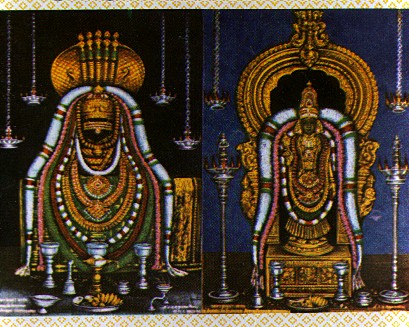
The gods like to flower those who deserve liberation through their devotion to a diety, or else the diety of their caste or one of their own choice. The Gods also watch over the destruction and the evolution of the worlds. At the very modest level, they are posed to be the caretaker of the Dharma in the Village of that religion or region to be said.
Holy Mountain Tiruvannamalai

The story of the Sacred mountain from the ancient times tells us that a quarrel between the Lord Vishnu and Lord Brahma depicts the origin of the mountain. Both the creator and preserver of this universe were fighting to claim who is powerful among them. This went on for year and years. The sage Narada also convinced them that neither of the two were powerful nor Supreme. Then, the Lord Shiva made up his mind to show the truth, who is actual Supreme among two. To prove this he took the form of fire which was very big and immense. This fire stood in front of the two and a voice was heard from the fire, which was Lord Shiva himself and told that "Among you two who will first approach the top and bottom of this dazzling fire will be said to be the most powerful forever." Then Brahma, changed himself as a swan and flew up to the sky to reach the top of the Fire and kept flying for hundreds and hundreds of years. But could not reach the top on the other side, Lord Vishnu changed himself as a boar and starting digging down the Earth to find the bottom.
Who also did the same thing over couple of years and could not ever find the bottom. Then both of them realized that Lord Shiva, he who is endless without the start nor an end was only the "Superior" among both of them. Their fight had got a conclusion. They came back to Earth and bowed in front of the Shiva, who was in the form of dazzling form of fire and requested to stay in the same form on this Earth and bless the devotees Who is He the actual meaning for the power of creation nor preservation, Lord Shiva agreed to stay in the same form and transformed himself as a mountain. From then, every Karthikai Deepam Festival the column of dense fire comes to the sight on the top of mountain. At Thiruvannamalai this is done on the 10th day of this festival Karthikai Deepam.
Importance

This temple is one of the "Panch Boodha Sthalams" and it is "Agni" Sthalam. It has also the importance as "Padal PetraSthalam". That is the four famous 'Saiva Saints and Poets' such Appar, Sundarar, Manichkavasakar and ThirugnanaSambandar made several poems on Lord Arunachaleswara.
Sunday, October 7, 2012
Brihadeeswarar Temple, Thanjavur

This temple is one of India's most prized architectural sites. The temple stands amidst fortified walls that were probably added in the 16th century. The vimana — or the temple tower — is 216 ft (66 m) high and is among the tallest of its kind in the world. The Kumbam (or Kalash or Chikharam) (apex or the bulbous structure on the top) of the temple is not carved out of a single stone as widely believed. There is a big statue of Nandi (sacred bull), carved out of a single rock, at the entrance measuring about 16 feet long and 13 feet high. The entire temple structure is made out of hard granite stones, a material sparsely available in Thanjavur area where the temple is. Built in 1010 AD by Raja Raja Chola in Thanjavur, Brihadeeswarar Temple, also popularly known as the ‘Big Temple', turned 1000 years old in 2010.

Brihadeeswarar Temple is a magnificent temple, situated in the Thanjavur district of Tamil Nadu. It dates back to the 11th century and was founded by the Chola King Rajaraja Chola I. The temple is considered to be an architectural wonder and is the perfect example of the expertise of the erstwhile Chola rulers, who once ruled over the peninsular India. One of the tallest temples of the world, Brihadeeswarar Temple is designed in such a way that the vimana never ever casts a shadow on the ground at noon.
Brihadisvara Temple has been built as per the South Indian style of temple architecture. It is dedicated to Lord Shiva, whose idol has been kept in the Garbha Griha (sanctum sanctorum). There is a tall sanctum tower (srivimana) inside its complex, along with splendid gopurams (elaborate gateways). A fully carved structure, Brihadeeshwarar Temple was designed by the chief architect of the Chola court, Sama Varma. It stands on a 29 m square base and rises to a height of somewhere around 65 m.
Surrounding the Brihadeeswarar Temple is a huge compound, with walls that are over 15 m high. Only the inner sanctum sanctorum, along with the gopuram (tower) adorning its top, was constructed by Rajaraja Chola I. This construction took a period of twelve years. To further enhance the beauty of the temple, the king got it adorned with a 12.5 feet tall finial, which is made of 9.25 kg of copper and is plated with 800 gm of gold. Subsequent rulers of the Chola dynasty added to the temple, never once letting the construction go out of sync.
The entrance of the Brihadeeshwarar Temple leads to a huge rectangular enclosure, which has been lined with stones. Moving through the corridor, one comes across a stone statue of Nandi Bull (the mount of Lord Shiva) and then, two idols of Lord Ganesha. Thereafter, one reaches the sanctum sanctorum (garbha griha), where the deity has been enshrined. The inner walls of the garbha griha illustrate 108 dance poses enacted by Lord Shiva. There are numerous inscriptions also, which are said to give details of the modern times.
The tower situated to the right of the temple is also an architectural beauty. The topmost tower comprises of a huge dome, made of black granite and weighing around 80 tons. The sanctum tower, or the srivimana, is surrounded by a rectangular prakara or corridor that comprises of two squares. The main tower is situated in the center of the rear square, while the vimana has 16 tiers and measures 200 feet in height. As per the India mythology, the point where the tower stands represents Mt Meru, the center of the universe.
Thursday, September 27, 2012
Sri Thendayuthapani Temple, Singapore

Sri Thendayuthapani Temple also known as Chettiars' Temple is one of the oldest temple in Singapore and was built in the year 1859 A.D. by Nattukkottai Chettiars. Chettiars' Temple Society , the management body of Sri Thendayuthapani Temple also maintains another temple called Sri Layan Sithi Vinayagar Temple located in the center of China Town at 73, Keong Saik Road.
Sri Thendayuthapani temple listed in Singapore Tourism Board, as a tourist attraction, has a picturesque location and magnificent vicinity. It sprawls over a spacious area and is airy and bright.
The main deity of this temple is Lord Thendayuthapani also called Murugan. Lord Thendayuthapani has other names such as Balasubrahmanyan, Shanmukhan, Swaminathan, Vallimanalan, Palaniandavar, Arumugan, Saravanan, Sevar Kodiyon, etc.

The Temple has a beautifully decorated "Alangara Mandapam" which is used on auspicious days to place the procession deity.
Poojas are performed by Pandarams for deities in Sri Thendayuthapani Sanctum and by Sivacharyas (Brahmins) for deities in other sanctums.
As a landmark of all the Hindu Temples in Singapore, 75 feet tall RAJAGOPURAM was completed in 1983. The consecration ceremony was conducted on 24-11-1983. Subsequently the whole temple was renovated and repainted again in 1996, followed by Maha Kumbhabishegam (Consecration Ceremony) held on 29-11-1996.
In 1983, modern amenities were added to the temple facilities along with the consecration ceremony, including a Wedding and dining hall.
Now, the temple has a separate staff quarters, a library, an office room and a spacious and well-decorated stage for cultural performances during special occasions.
Every year six important festivals are celebrated with great pomp and grandeur, which are: Thai Pusam, Letcha Archanai for Meenakshi Amman & Durgai Amman, Navarathri, Skanda Sashti and Thiru Karthigai. Click here for more details on festivals and occasions.
Annadhanam (Free Lunch)
On the occasion of Guru Poojai and Karthigai (an auspicious day falling on every month), delicious varieties of dishes is being served to the devotees in the afternoon after the prayer. The contact details for the temple is as follows,
Sri Thendayuthapani Temple (also known as Chettiars' Temple)
15, Tank Road,
Singapore 238065
Phone: +65 - 6737 9393
Fax: +65 - 6735 0804
Friday, September 21, 2012
Sripuram Golden Temple

The Golden Temple was built in a short span of 7 years. It was inaugurated on August 24, 2007. The consecration ceremony was witnessed by thousands of devotees. Since then, the temple has attracted hundreds of thousands of devotees; often breaching the 1 lakh mark on special occasions. The temple has also changed the face of Thiruamalaikodi village and the nearby town - Vellore. In the coming years, the temple envisages to create a positive influence on the society and ultimately bring about a change.
The Golden Temple is situated in a 100 acre lush green landscape in the middle of a star-shaped path, such that it absorbs maximum energy from nature, which creates enormous peace and brings relaxation to the devotees who walk through the starpath. Devotees walking through the starpath are blessed to read messages of truth and righteousness that enables them to realize themselves and transform into powerful beings. The ultimate purpose of the Golden Temple is to create righteousness and transformation in human beings.
Star Path:
- The star-shaped path with twelve ‘auspicious’ vertices creates a divine energy form on the Earth, akin to the sacred Srichakra.
- Messages of truth and righteousness are posted on both sides of the pathway to encourage people to read them and imbibe their meaning as they walk slowly towards the Temple. These messages will cover topics such as the purpose of human birth and human life, the things we should and we should not do, the need for devotion and many more.
- Walking through the starpath, laid with these messages, creates a rejuvenating experience and reminds oneself of the true purpose of life and nature of the world.
Landscape:

The landscape of Sripuram is completely natural, created and managed using organic manure. One feels closest to one's true self in this serene ambience. Water from all the major rivers of the country were brought to create the Ecopond - ''Sarvatheertham''. The creation of this pond has resulted in a wonderful ecosystem for birds and insects, complemented by over 20,000 saplings of various species.
Dharshan Timings:
4.00am to 8.00 am Abishekam
8.00am to 8.00 pm General Dharshan
6.00pm to 7.00 pm Aarthi Seva
Tiruchi Uchi Pillayar Kovil

The Rock Fort temple stands 83m tall perched atop the rock. The smooth rock was first cut by the Pallavas but it was the Nayaks of Madurai who completed both the temples under the Vijayanagara empire.
The temple is situated at the top of the rock. The temple is mystic in its nature with an awe-inspiring rock architecture. The Ganesh temple is much smaller with an access through steep steps carved on the rock and provides a stunning view of Trichy, Srirangam and the rivers Kaveri and Kollidam. Due to its ancient and impressive architecture created by the Pallavas, the temple is maintained by the Archaeological department of India.
Mythology of the Vinayaka temple
Vibhishana, was the younger brother of the Asura King Ravana who ruled Lanka. Lord Rama in the epic of Ramayana rescues his wife Sita, who was kidnapped and held by Ravana, with the help of Sugriva and Hanuman defeated him. In this war, the moral and truth-abiding brother of Ravana, Vibishana aids Rama in his battle against his brother. Ultimately Rama wins the war and as a token of love, He gifts Vibishana a vigraham (idol for worship) of Lord Ranganatha, a form of Vishnu.Vibhishana, though he supported Rama, was basically an Asura, hence the Devas (who are arch rivals to Asuras as per Hindu mythology) wanted to stop this idea of an Asura taking Lord's supreme form to his Kingdom. They request the help of the Remover of obstacles and God of learning, Lord Vinayaka and the Lord accepts the plan. Vibhishana, while on his back to his Kingdom, goes through Trichi, and wanted to take his bath in the river Kaveri and do his daily rituals. However, he is perplexed as the deity, once kept in land, can never be removed and has to be in that place forever.
As a solution, Vibishana tries to find someone to hold the deity while he was taking bath. He finds the Lord Vinayaka under disguise of a cowherd boy. As per the plan, when Vibishana is fully into water, Vinayaka takes the deity and keeps it firmly in sand, in the banks of kaveri. On seeing this, the angry Vibhishana chases the boy, to punish him, and boy keeps running and climbs over the rock near the Kaveri bank. Vibhishana finally reaches the boy and hits him on the fore-head of little boy who then reveals himself to be Vinayaga. Vibishana immediately apologizes and the Lord gives him his blessings and sends him off to Lanka. This is similar to the story Of Lord Ganesh in Gokarna with Ravana in the same Ramayana period..

Ref Gokarna
The place on which the Ranganathan deity was kept was later covered in deep forests, due to disuse and after a very long time, it was discovered when a Chola king chasing a parrot found the deity accidentally. He then established the Ranganathaswamy temple, Srirangam as one of the largest temple complexes in the world. Meanwhile, the Pallavas built the Vinayaka temple and the Thayumanaswamy temple, in the rock which Vinayaka used to escape Vibishana.
Ervadi Dargah

Ervadi is a village where the grave and shrine of Qutbus Sulthan Syed Ibrahim Shaheed Badusha Radiyallh Ta’ala anhu, the then ruler of Madinah Al Munawwara is found. It is a town located in the Kadaladi taluk of Ramanathapuram District in southern tamilnadu. It is located on the sea shore in between keelakarai and Valinokkam. The town is well known only for the shrine of Hazrat Sultan Syed Ibrahim Shaheed badusha radiyallah ta’ala anhu.Erwadi being a small town, is the second largest contibutor for the revenue of Ramanthapuram District.

Urus Festival
The Grand urus festival of Ervadi dargah is held every year in the Islamic Month of Dhu al-Qi’dah commemorating the shahadat anniversary of Hazrat Qutb Sulthan Syed Ibrahim Shahid badhusha radiyallah Ta’ala anhu. The Grand festival starts on 1st of Zul Qaida and ends on 30th of Zul Qaidah of every Hijri year.Pillayarpatti Karpaga Vinayagar Temple

Karpaga Vinayagar koil is one of the oldest Cave Temples (Rock Cut) temples of Tamilnadu and situated at Pillayarpatti, which is between Pudukkottai and Karaikkudi. The nearest airport is at Tiruchirappalli, Chennai. Rameswaram Express and Kamban Express travel to these two railheads.
The town of Pillaiyarpatti is named after 'Pillayar' - the tamil name for Ganesha, and this ancient temple houses rock cut images of Shiva, Lingodbhavar and others as well as several other shrines. Steeped in the tradition of Agamic textsthe temple bears testimony to the vibrant temple culture of the Tamil people, passed down through centuries.
Antiquity:
Over 15 inscriptions are found within the temple, that help establish the age of the temple. The Stalapuranam published by the temple classifies the growth of this temple into three distinct stages.The first stage goes back in time by about 1600 years. During this period, the innermost rock cut shrines housing Karpaka Vinayakar and Tiruveesar came into being. The uniqueness of the image of Ganesha is one factor testifying this date; the characters used in the temple inscriptions also help establish this date. The pillars within the shrine are of pre-Pallava origin.
The Pallavas were prolific builders of rock cut temples (Mahabalipuram, Mahendravadi, Mamandur, Mandakapattu, Seeyamangalam, Namakkal, Tiruchi, Nartamalai, Kudumiyanmalai, Tirukkokarnam, Tirumeyyam, Peraiyur, Malayadipatti, Tirukolakkudi, Kunrakkudi etc.). A number of these can be traced to Mahendravarman I (615 - 630 AD) and Narasimhavarman I (630 - 668 AD). However, the inscriptions at Pillayarpatti date further back to the 4th century AD. Also, given the location of the temple in the Pandya kingdom it would only be logical to associate Pandya patronage to this temple, especially in the light of Pandya patronage at the Kazhugumalai temple not too far from here. There are several inscriptions within this temple that date back to the period between 1091 AD and 1238 AD, making it apparent that the Pillayarpatti Nagarattar became the custodians of the temple during the 13th century AD during the second growth phase of this temple, when Vimanams and Rajagopurams were built.
The third phase of growth is much more recent and it involved the repair, rebuilding and refurbishment of the entire temple complex, including the renovation of the temple tank. The tank and the two Raja Gopurams provide an attractive approach to the temple, in this rather remote town of Pillayarpatti.

Deities:
Karpaka Vinayakar or Desi Vinayaka Pillaiyar is the presiding deity here, and he is portrayed with two arms and a trunk curled towards his right in the valampuri mode. This 6 feet tall mammoth image of Ganesha is a bas relief in an excavated cave, off of a hill in the precincts of the temple. Scholars says that Lord Vinayaga is the Lord of wisdom, which is confirmed by the head of elephant in the shape of sacred mantram "OM". When we draw a line from the broken left tusk, starting upward, then turning left to wards right ear and after passing through the bended left tusk up to the tip of trunk, Tamil alphabet "O" appears. The Lingam in the hand indicates the alphabet "M". Together they form "OM". This is confirmed by the lord here "Valamburi Pillayar". As Vinayagar satisfies the wishes of his devotees like Karpagam tree, he is also known "Karpaga Vinayagar".Here Lord Vinayaga appears with 2 hands unlike in other places where he is seen with 4 hands. Also he is seen seated without Angusapasam, with his legs folded and stomach not touching the Asanam in the form of "Artha Padma" Asanam.
The word Vinayaga means "Incomparable Leader" Devotees worshipping Valamburi Vinayagar seated facing towards north, will be blessed with all wealth. Chanting of sacred mantrams by the student learning Vedas and agamas in the Vedaagama School create a divine atmosphere.
The deity of this temple is known as "Marudeeswarar" as Marudha tree (In Sansscrit Arjuna Virutcha,Tne Botanical name is Termanalia Arjuna) worship is followed in this temple which indicates that this temple in an ancient temple. The sculptur of pasupatheeswarar, "A cow worshipping Lord Siva by offering his milk" is the special feature of this temple. Also kubheran the Lord of wealth had worshipped at this temple.
To illustrate the information that one where controls his five senses will be able to understand God, a sculplure of five headed snake wearing a Lingam on its neck is found here. The five head of the snake indicate the five senses while the Lingam indicates God. Also adding to the sprituality Goddess Laxmi, Saraswathi and Durgai are found together at the same sport.
Unlike other places the three Lingams Thiruveesar, Marudheesar and Senchadeswarar and the three Goddess Sivagami amman, Vadamalar Mangaiamman and Soundara Nayaga amman all appear together at the same place and bless the devotees.
It is believed that by worshipping Kathyayini amman at this temple women get relived from sevvai dosham which prevent them from getting married. "Sabda Madhar" whom importance due to changing time are provided with a seperate sannidhi known as Sakthi sannidhi at this temple.
Subscribe to:
Posts (Atom)